Search
HARTING Component Carrier

Component carriers simplify the mounting of sensors

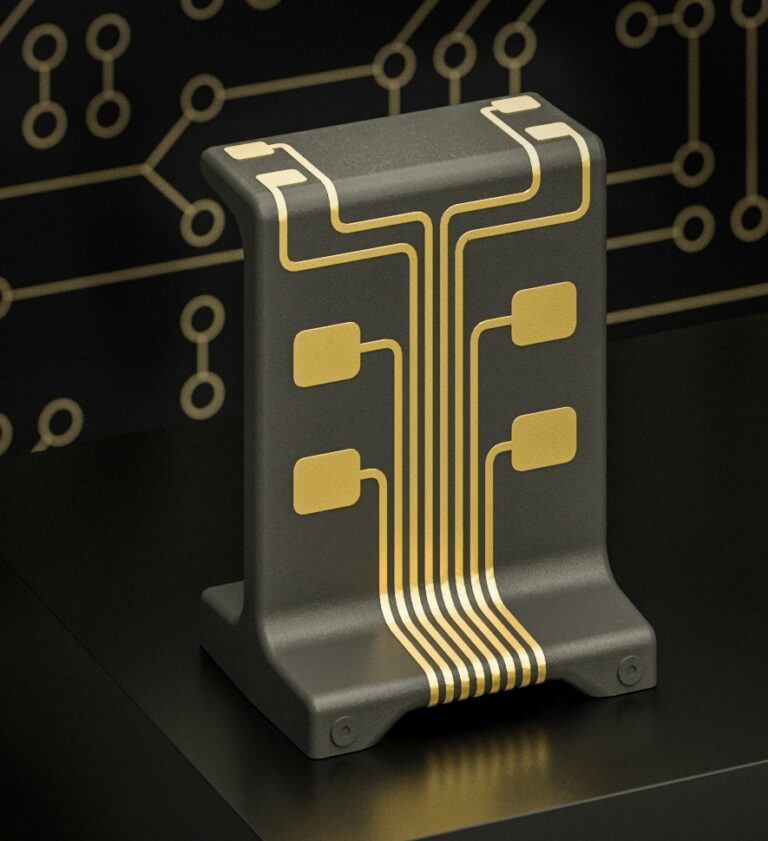
HARTING has developed a component carrier that can be mounted directly with electronic components allowing previous manual assembly processes to be automated. Flexible circuit boards can also be replaced, increasing precision and reducing assembly costs.

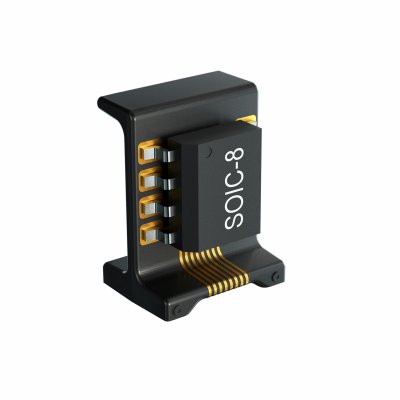
The component carrier simplify the mounting of sensors which serves as a connecting element between a printed circuit board (PCB) and electronic components (such as LEDs, ICs, photo–diodes or sensors).
Bauteil Traeger
With the component carrier from HARTING, the manual mounting of position sensors is no longer necessary. The component carrier increases reproducibility and reduces processing costs.

Automatic mounting of position sensors

In electrical drives, Hall sensors are used to determine the exact position of the rotor and the electronic components are normally attached manually as wired THT components. A mechanical bracket is also mounted which aligns the sensors at an angle of precisely 90 degrees.
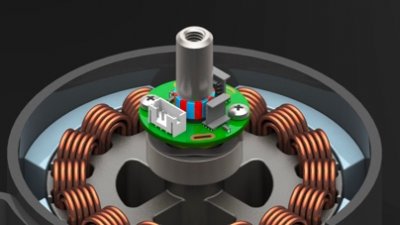
Hall Effekt Encoder
Two-channel Hall-effect encoder for recording the rotation of a motor shaft

Such manual assemblies are no longer necessary when HARTING’s component carriers are used because the sensors are automatically mounted onto the component carrier, making an additional component for arranging and aligning the sensors unnecessary. The component carrier with the position sensors is delivered by HARTING in a blister belt packaging (tape & reel) for the automatic SMD assembly process. This component carrier replaces the manual processing steps – thus increasing the reproducibility and reducing the processing costs.
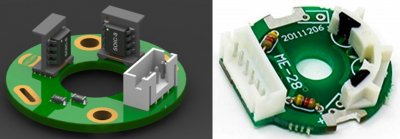
Bauteiltraeger Loesung und traditionelle Loesung
Component carrier solution & traditional solution

About HARTING 3D-MID

HARTING 3D-MID is offering the complete value chain for 3D-MID technologies from a single source, including development/prototyping of customer-specific products, injection moulding, laser direct structuring, metallisation, assembly and connection technology, as well as final inspection. Its core business is the production of mechatronic components for automobile manufacturing, industry, medical technology and sensor systems. HARTING is the largest supplier of 3D-MID components outside of Asia. HARTING 3D-MID is a business unit of the HARTING Technology Group, headquartered in Espelkamp, Germany.

More news

3D-MID vs. Flex PCBs: Choosing the Right Technology for Your Application

When designing modern electronic devices, engineers often face the choice between flexible printed circuit boards (Flex PCBs) and 3D-MID (3D-Mechatronic Integrated Devices). Both technologies offer unique advantages and limitations, making the selection process highly dependent on the specific requirements of each application. Flex PCB Advantages: Disadvantages: 3D-MID Advantages: Disadvantages: When to Choose Which Process? Key

3D-Circuits drug delivery implant

3D-Circuits Technology: An Innovative Approach to Compact and Efficient Electronic Design

As product requirements evolve, engineers and designers search for solutions that enable greater integration, miniaturization, and reliability without compromising on quality or design flexibility. 3D-MID (Three-Dimensional Mechatronic Integrated Devices) technology offers a practical solution to these challenges by integrating electronic circuits onto the surfaces of molded parts. What is 3D-MID? 3D-MID, also known as 3D-Circuits,

HARTING revolutionizes 3D printing of LDS materials using Hot Lithography

HARTING AG, a leading provider of 3D MID solutions, and Cubicure GmbH, a pioneer in 3D printing, announce a groundbreaking collaboration to introduce 3D printing of LDS (Laser Direct Structuring) materials. Until now, 3D printing of MID prototypes has been limited due to resolution and material compatibility. Printing methods such as FFF/FDM were affordable but

HARTING - 3D-MID
REGISTER NOW

Never miss 3D-MID news again!

Just register for our Newsletter